
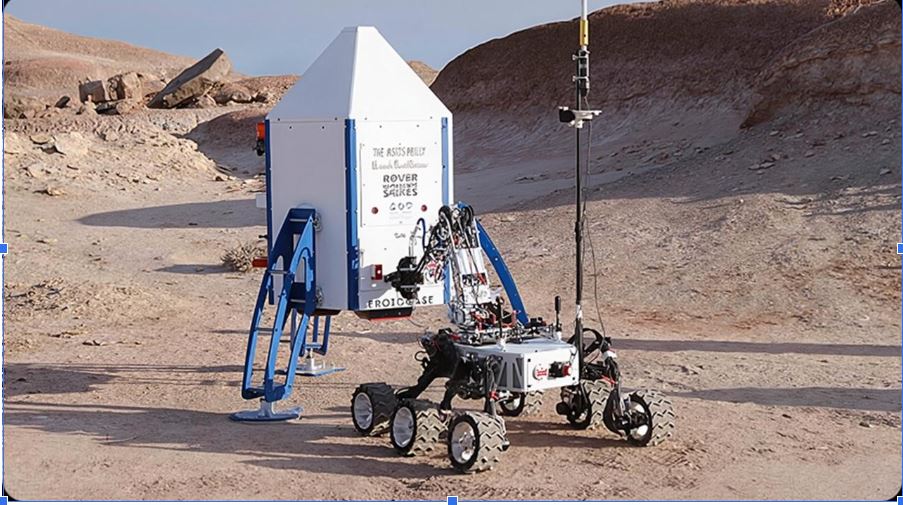
Wheeled Robot Motor is important in logistics, automation, inspection, and service. They have high requirements in the form of motors that are required to carry heavy loads, deliver steady torque and remain dependable in harsh environments. This article discusses important characteristics that make such motors reliable, which help the engineers and designers in the selection of appropriate actuators.
How Does High Radial Load Capacity Contribute to Motor Reliability?
The lateral force that a motor experiences during the drive of a wheel or hub is known as radial load. These forces are problematic for the standard motors, leading to higher bearing wear and reduced torque effectiveness. Reinforced housings, precision gearboxes and impact resistance are made to gain high radial load capacity in modern wheeled robot motors such as CubeMars actuators, which have over 50% higher radial load capacity than most models. It enables them to manage the weight and external forces of the platform during maneuvering or collision, which guarantees prolonged reliability and fewer maintenance needs.
Why Is Torque Density Important for Wheeled Robot Motors?
The density of torque, expressed as the torque output to the weight of the motor, is a key parameter of mobile robots. The large torque density enables the motors to produce enough driving force with the bare minimum system mass. Compact, precious brushless DC motors with planetary gearboxes are used as compact assemblies in low-torque motors and include extra gear reduction stages in order to increase efficiency and reduce failure points. They offer a steady torque at varying loads, thereby making it possible to move wheeled robots reliably. In the case of AGVs and industrial platforms, this enhances navigation and minimizes the risks of the system.
How Does Multi-Mode Control Enhance Motor Reliability?
The motor control modes define the motor response to position, speed or torque command. Conventional motors are often based on single-loop position control, which may cause oscillation or overshoot when the robot meets an irregular surface or a sharp change in load. Contemporary wheeled robot motors have multi-mode control, a combination of position, velocity, and torque loops to control and stabilize the robot’s behavior. Others have MIT hybrid modes to optimize responsiveness to dynamic loads. Such strategies allow coordinated operation of motors, which improves the stability of the system. Multi-mode control is useful in tuning the differing situations by providing specific control, which enhances the reliability of the mobile robots.
Why Is Integrated Architecture a Key Reliability Feature?
The concept of reliability does not only concern the motor itself, but it also relies upon the suitability of the motor combined with its control electronics and mechanical components. Modular architecture.. The motor, gearbox, driver and encoder are combined into one unit, simplifying wiring and eliminating potential failure points due to connectors or misalignment. Integrated architecture CubeMars has integrated motors, which have simplified implementation and maintenance, along with reducing electrical problems due to the use of plug-in connector designs such as 2+5 PIN, which combine power and signal lines. Their reduced external dependency, standardization of modules and stable performance with less downtimes suits well with the industrial and inspection robots that need to operate continuously or remotely.
How Do Encoder Systems Contribute to Motor Accuracy and Reliability?
Encoders give feedback on the position and speed of the motor, which is important in accurate control. Single-turn memory in dual encoders on modern wheeled robot motors allows storing of absolute position during periods of no power to resume operation as soon as possible, with additional operation delay costs. They increase redundancy and proper feedback during vibrations or interference, which is essential to the safety and work of inspection and logistics robots.
How Does Adaptive PID and Auto-Tuning Improve Reliability?
PID (Proportional-Integral-Derivative) control algorithms are used to control the motor response to allow control of desired speed, position, or torque. Manual adjustment of PID parameters may be fallible and time-consuming, especially when the robot is being used over changing loads or in changing environments. Auto-tuning and adaptive PID motors are able to adjust their control parameters automatically based on feedback to provide the best performance with no manual recalibration needed. This minimizes vibration, restlessness or heating. In the case of wheeled robots, this implies high levels of consistency during their operation in a variety of tasks, such as transporting heavy loads and maneuvering in a limited area.
How Do Gearbox Designs Affect Motor Durability?
Gearboxes are devices that convert the motor speed into the wheel torque and define efficiency and load-handling capabilities. Wheeled robot motors are often readied with precision planetary gearboxes, as the gears and teeth spread the load across many, instead of localized, and decrease the stress. Planetary gearboxes of high quality are known to provide smooth torque, wear resistance and offer minimum backlash, resulting in dependable robot motions. Two-stage compression, such as 39:1 or 6:1, will allow efficient motor operation with varying speed and torque without overloading to allow operational durability and stable operation.
Why Is Modular Customization a Valuable Feature?
The performance requirements of different wheeled robot applications are different. There are robots that put more emphasis on high-speed inspection and those that require extreme load-handling to be used in warehouse logistics. Motors that can be customized to vary in gear ratios, voltage ratings, and torque output can be used by engineers to precisely fit a platform without compromising reliability or performance. CubeMars has customizable solutions that can change to fit a platform without losing their reliability or performance. Such flexibility assists manufacturers to release motors that are optimized as regards performance, life and efficiency and minimize downtime or mechanical troubles failure.
Conclusion
Wheeled robot motors are a combination of mechanical electrical and control characteristics. Performance during different conditions is ensured by high radial load, torque, multi-mode control and integrated design. State-of-the-art encoders, PID adaptive, and safety ensure accuracy and reliability. Modern wheeled robot actuators are more durable with precision planetary gearboxes and modular products, being more suitable than traditional motors in a variety of applications such as supporting logistics, inspection, automation, and service tasks. The choice of a motor with such characteristics will provide a reliable, efficient, and safe operation in extreme conditions. CubeMars wheeled robot motors are reinforced, load-bearing, have two encoders, multi-loop control, and integrated driver modules, which guarantee a reliable mobile platform operation.